


Petra
Often called the “Rose City” due to the colour of its stone, Petra is a historical and archaeological city in southern Jordan
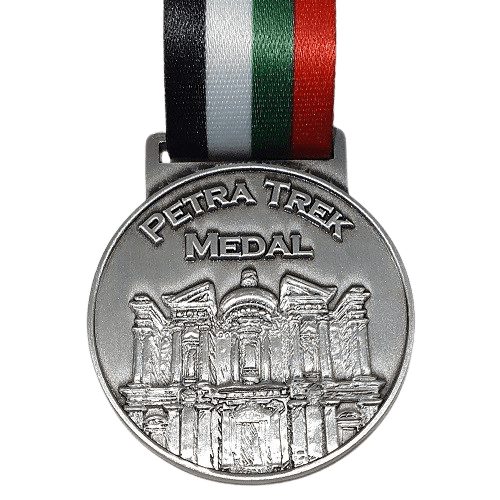
The medal is die-cast and crafted from zinc alloy with antique nickel plating and has a rugged look with Petra and the words themselves in 3D. The reverse of the medal is flat and suitable for engraving.


‘The Hashemite Kingdom’
Celebrating the Heritage of Jordan
Our unique medal ribbon is 2.5cm wide by 45cm long (total ribbon size is 90cm) and the colour bands signify the flag of Jordan.
The black, white and green colours represent the Abbasid, Umayyad, and Fatimid caliphates, respectively. The red chevron symbolizes the Hashemite dynasty and the Arab Revolt. The seven-pointed star represents the unity of the Arab people and the seven verses of the Quran’s first chapter – ‘The Opening’ (Al-Fatiha).
Celebrating the Heritage of Petra
Petra, often called the “Rose City” due to the color of its stone, is a historical and archaeological city in southern Jordan. It was the capital of the Nabataean Kingdom and is famous for its rock-cut architecture and water conduit system.
Early History (Pre-Nabataean Period)
● Prehistoric Era: Evidence suggests that the area around Petra was inhabited as early as 7000 BCE by Neolithic peoples.
● Edomites (Iron Age): By the 8th–6th centuries BCE, the Edomites, a Semitic people, settled in the region.
The Nabataean Kingdom (4th Century BCE–106 CE)
● Nabataeans Arrive: The nomadic Nabataeans, an Arab tribe, began settling in Petra around the 4th century BCE, taking advantage of its strategic location along trade routes.
● Prosperity Through Trade: Petra became a major hub for the incense trade, linking Arabia, Egypt, Syria, and the Mediterranean.
● Architectural Marvels: The Nabataeans carved elaborate structures, such as Al-Khazneh (The Treasury) and Ad-Deir (The Monastery), into the sandstone cliffs.
● Water Management: They engineered an advanced water system with dams, cisterns, and channels to control flash floods and supply the city.
Roman Annexation (106 CE–4th Century CE)
● Conquest by Rome: In 106 CE, the Roman Emperor Trajan annexed the Nabataean Kingdom, making it part of Arabia Petraea.
● Continued Prosperity: Petra remained an important trade center under Roman rule, and new structures like the Roman-style theater and Colonnaded Street were built.
● Gradual Decline: As trade routes shifted to sea routes (e.g., via the Red Sea), Petra’s importance diminished.
Byzantine and Islamic Periods (4th–7th Centuries CE)
● Christian Influence: In the Byzantine era (4th–6th centuries CE), Petra became a Christian center, with churches like the Petra Church built.
● Islamic Conquest: The city came under Muslim rule in the 7th century but was largely abandoned except for nomadic use.
Abandonment and Rediscovery
● Earthquake of 363 CE: A major earthquake damaged much of Petra, accelerating its decline.
● Forgotten by the West: By the Middle Ages, Petra was lost to the Western world, known only to local Bedouins.
● Rediscovery (1812): Swiss explorer Johann Ludwig Burckhardt rediscovered Petra in 1812, reintroducing it to the West.
Modern Era (20th–21st Centuries)
● Archaeological Studies: Extensive excavations began in the 20th century, uncovering tombs, temples, and artifacts.
● UNESCO World Heritage Site (1985): Petra was designated a UNESCO World Heritage Site in 1985.
● New Seven Wonders (2007): It was voted one of the New Seven Wonders of the World in 2007.
● Tourism & Preservation: Today, Petra is Jordan’s most visited tourist attraction, though conservation efforts continue to protect it from erosion and human impact.
Petra remains a symbol of Jordan’s rich heritage and an enduring testament to the ingenuity of the Nabataeans.





Reviews
There are no reviews yet.